
LlmWikis.org / public handbook
The practical standard for building LLM Wikis.
LlmWikis.org teaches how to build, structure, maintain, audit, and repair human-readable, machine-consumable knowledge systems where durable organizational knowledge is owned, reviewed, trust-labeled, citable, retrieval-ready, and safe for AI agents to use.
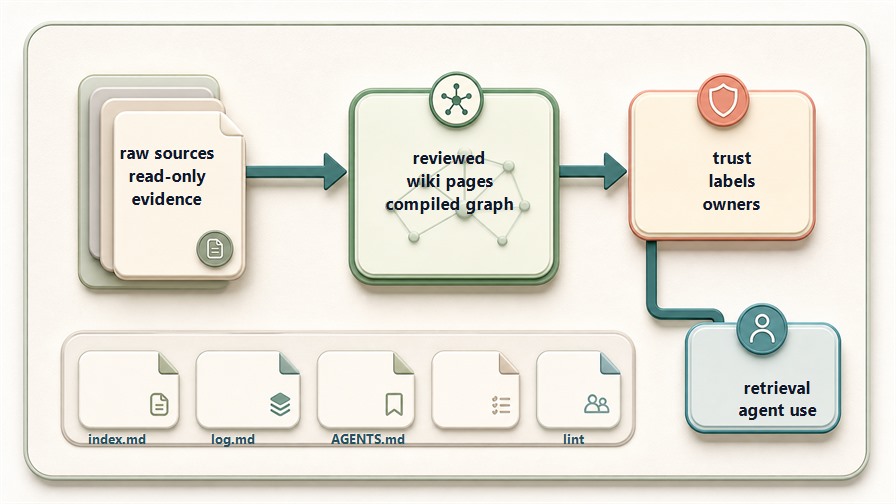
Raw sources become reviewed pages, trust labels, and retrieval-ready context for people and AI agents.
Handbook search
Search the handbook
LLM Wiki standard, build guide, and starter bundle.
UAIX.org remains canonical for UAI-1, AI Memory, Project Handoff, schemas, validator behavior, and UAIX specifications.
Definition, structure, governance, agent rules, templates, comparisons, source map, and llms.txt.
No open editing, live benchmarks, live MATM runtime, public MCP, write API, certification, or multilingual support.
Handbook routes
Four entry points cover the durable knowledge system: concepts, build path, governance, and agent integration.
Understand
Define the pattern, compare it with nearby memory shapes, and pick the first reader path.
- Start HereOrientation, first skeleton, learning path.
- What Is an LLM Wiki?Definitive concept and normal-wiki distinction.
- Why LLM WikisContext loss, stale docs, onboarding, unsafe AI use.
- LLM Wiki vs RAGCurated source material versus retrieval technique.
- LLM Wiki vs AI MemoryDurable knowledge base versus portable context packet.
- Governed MATMShared agent experience through proposal-only events and curator review.
Design and build
Turn the handbook model into folders, templates, source rules, and metadata.
- How To BuildImplementation path from skeleton to review workflow.
- Setup WizardShared human and AI planning path for setup details.
- LLM Wiki StructureFolders, pages, ownership, and durable paths.
- Open Knowledge FormatUse OKF as the file-native bundle shape while LLMWikis adds governance.
- Starter TemplateDynamic ZIP and canonical templates.
- MATM ProfileScopes, kinds, operations, schemas, and support boundary.
- Content TypesWhat belongs, what stays out, and why.
- Metadata StandardRequired frontmatter and agent-readable fields.
Operate and govern
Keep sources reviewed, labels honest, permissions clear, and stale claims visible.
- OperationsIngest, query, lint, contradictions, and refresh.
- MATM CurationValidate, redact, dedupe, review, and admit scoped memory.
- Trust ModelAuthoritative, draft, historical, deprecated, proposal.
- GovernanceOwnership, review cycles, approval, and archival rules.
- Security and PrivacySecrets, data, redaction, permissions, and exports.
- Maturity ModelMove from document dump to operational knowledge system.
Integrate
Make the wiki useful to agents, handoffs, retrieval, protocol case studies, and checks.
- For AI AgentsRead, cite, update, and stop at approval boundaries.
- Memory EventsWorkers propose durable memory without writing it directly.
- Implementation ChecklistActionable steps for teams.
- NavigationIndex, log, graph links, and retrieval routing.
- Protocols and Case StudiesNon-normative ecosystem map.
- LLM Wiki + UAIPersistent memory plus assertion boundaries.
Choose the right memory shape
I want to build an internal knowledge base
Use an LLM Wiki
with owners, metadata, trust labels, review cycles, and agent rules.
I want to give an AI agent context for a project
Use AI Memory
as a portable context bundle linked back to durable wiki pages.
I want to transfer a project to another team
Use Project Handoff
the focused AI Memory pattern for ownership transfer.
I want better retrieval over company docs
Build an LLM Wiki plus RAG
curate the source before retrieval relies on it.
I want agents to reuse prior agent trajectories
Use governed MATM
with proposal-only Memory Events, scoped records, curator review, citations, and abstention.
I want to onboard a person or agent
Use durable source plus a smaller packet
from the LLM Wiki into an onboarding path or AI Memory packet.
Build this first
Define scope, create raw and wiki layers, add index.md and log.md, ingest one source, query from the index, then run lint before scaling.
- 1Define scope.
Start with one useful domain, not every document you own.
- 2Create folders.
Keep
raw/read-only, usewiki/as the OKF bundle root, and keep root schema compact. - 3Add navigation.
Create
wiki/index.mdandwiki/log.mdbefore ingest grows. - 4Ingest one source.
Analyze first, stage proposed updates, then write only reviewed wiki changes.
- 5Ask one question.
Route from the index, answer from local pages, and save only useful synthesis.
- 6Run lint.
Fix broken links, stale claims, missing source status, and contradictions before scaling.
For agents
Agents should enter through the handbook, cite local sources, stage updates for review, and stop when permissions or evidence are missing.
How agents should citeUse durable page links, source status, and local evidence instead of private chat memory.
How agents should updateAnalyze first, stage proposed wiki changes, then write only reviewed durable records.
How agents should emit memoryEmit proposal-only Memory Events; curator and reviewers decide durable admission.
When agents must stopStop on secrets, missing permission, unsafe data, unsupported claims, or unclear source authority.
Current evidence boundaries
Launch package
Definition, build guide, structure standard, trust model, metadata standard, agent guidance, security/privacy, dynamic starter ZIP, templates, and root discovery files.
Planned
Source-backed model and benchmark records, contributor policy, grouped search, CI lint recipes, and live integration tooling.
Not claimed
Open editing, live benchmark integrations, live MATM runtime, public MCP, write API, UAIX certification, multilingual coverage.
Canonical references: UAI-1, Project Handoff, Agent File Handoff.
Discovery files
Implementation modules
Open Knowledge FormatOKF bundle compatibility with LLMWikis governance, trust labels, source rules, and agent boundaries.
Trust ModelStatus labels, sensitivity, owner, review, and agent interpretation rules.
For AI AgentsRead order, citation, update rules, safety boundaries, and human-review gates.
Governed MATMShared agent memory profile with Memory Events, curator decisions, scoped retrieval, and tests.
Two-Step Ingest PipelineAnalyze, stage, review, write, and lint without single-pass drift.
Page Schema StandardFrontmatter, source trace, claim status, contradictions, and review dates.
Memory LifecyclePromotion, demotion, confidence labels, stale pages, and archives.
Graph NavigationTyped links, clusters, contradiction edges, and index-driven routing.
Tooling LandscapeHow to choose desktop apps, CLIs, adapters, search, and graph add-ons.
Reference-site posture
LlmWikis is organized around route density, status, source boundaries, search, and reusable paths. The starter path, discovery files, and evidence limits stay visible so humans and AI agents can find the right source before acting.
Source and authority boundary
LlmWikis teaches the pattern and links source material. UAIX.org remains canonical for UAI-1, AI Memory, Project Handoff, schemas, registry records, validator behavior, roadmap, and governance.